

LLC or S Corporation? Choosing the Right Structure for Your Business
Often it is not LLC or S corporation. Many businesses use an LLC for protection and elect S-corp tax treatment once the savings justify the compliance.
Ready to get started? Book a free 15-minute call with one of our client advisors and start preparing with confidence.
Schedule a New Client Call →Before making your business structure decisions, please reach out to our highly effective team of KKOS lawyers at 888-801-0010.
Start with the correct distinction
An LLC is a legal entity created under state law. It can separate business obligations from an owner’s personal assets when it is properly formed, maintained, capitalized, and operated. An S corporation, by contrast, is primarily a federal tax classification. A corporation may elect S status, and an eligible LLC may also elect to be taxed as an S corporation without converting into a state-law corporation. This distinction matters because liability protection, governance, and taxation are related—but separate—decisions.
How a standard LLC is taxed
A single-member LLC is generally disregarded for federal income-tax purposes unless it elects another classification. Its business activity is usually reported directly on the owner’s return. A multi-member LLC is generally taxed as a partnership unless it elects corporate treatment. These defaults provide flexibility and relatively straightforward administration, particularly for a new or modestly profitable business.
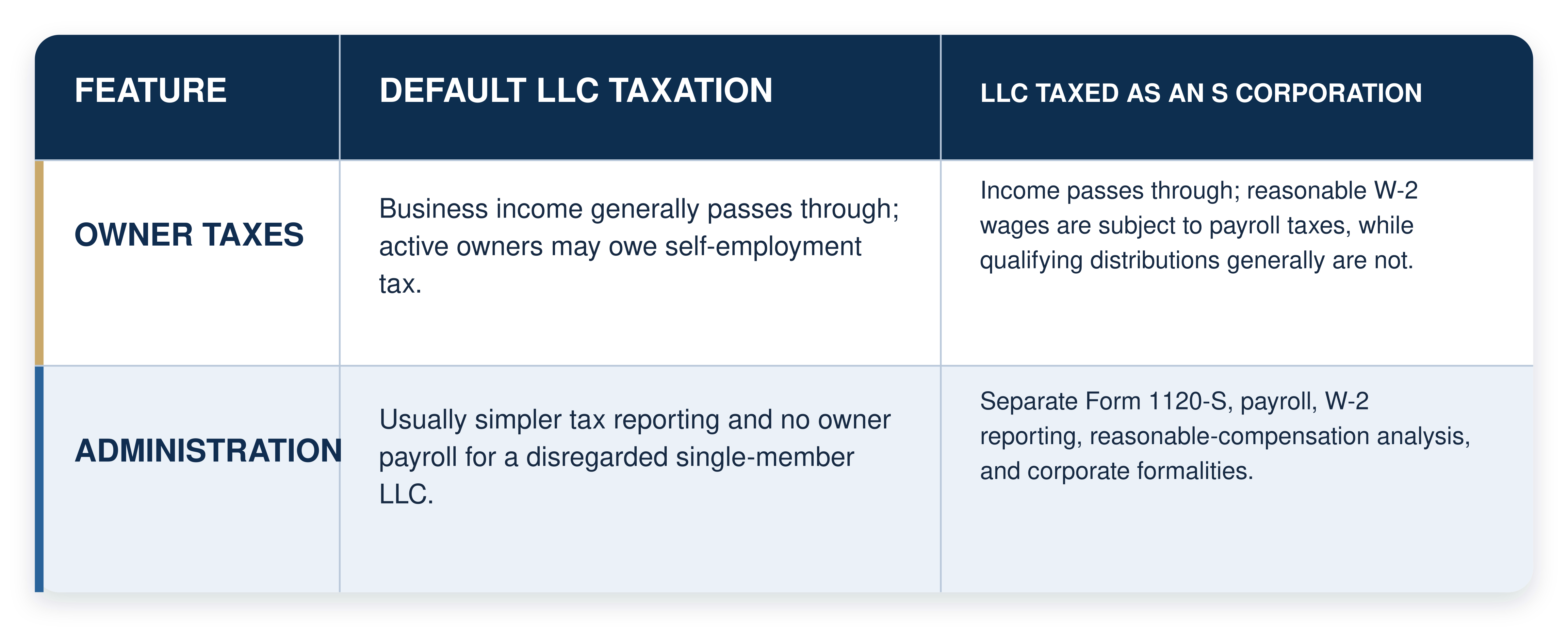
The tradeoff is that an active owner’s business income may be subject to self-employment tax, depending on the entity, the owner’s role, and the character of the income. An LLC does not automatically reduce taxes simply because it has been formed. Its value begins with legal separation, contractual clarity, management rules, and ownership planning.
What changes with an S-corporation election
An eligible LLC can elect S-corporation taxation by filing Form 2553 with the IRS. The business generally remains an LLC under state law, but files Form 1120-S and issues Schedule K-1s to its owners. Business income and loss continue to pass through to the shareholders, so the S corporation generally does not pay federal income tax at the entity level. State treatment may differ.
An owner who performs services for the business must generally receive reasonable W-2 compensation before taking non-wage distributions. Wages are subject to payroll taxes and withholding. Qualifying distributions above reasonable compensation generally are not subject to self-employment tax, which may create savings when the business produces enough consistent profit. The IRS may reclassify distributions as wages when an owner underpays salary, resulting in back payroll taxes, interest, and penalties.
When S-corporation taxation may make sense
An S election is worth evaluating when:
- The business has stable net profit exceeding a defensible market-rate salary for the owner’s services.
- Expected payroll-tax savings materially exceed payroll, bookkeeping, tax-preparation, and compliance costs.
- The owners are eligible S-corporation shareholders and can maintain the required ownership structure.
- The business is prepared to run payroll, make timely deposits, file employment returns, and document compensation.
There is no universal profit threshold at which an S election becomes beneficial. The answer depends on reasonable compensation, filing status, other wages, state taxes, retirement-plan goals, health-insurance treatment, and added professional fees. A projection comparing total tax and administrative costs under both structures is more useful than relying on a rule of thumb.
Legal protection still requires good operations
Neither LLC status nor an S election substitutes for sound business practices. Owners should maintain separate bank accounts and accounting records, sign contracts in the entity’s name, keep adequate insurance, document major decisions, avoid commingling funds, and maintain required state filings. Personal guarantees, the owner’s own misconduct, payroll-tax liabilities, and failure to respect the entity can still create personal exposure.
The practical approach
For many closely held businesses, the practical starting point is to form an LLC with a well-drafted operating agreement and use the default tax classification initially. As profit becomes reliable, the owner and CPA can model an S election. If the projected savings justify the additional payroll and tax administration, the LLC can often elect S-corporation treatment while preserving its existing state-law structure.
The right choice should account for the business’s owners, income, employees, industry risk, operating state, financing plans, retirement strategy, and potential sale. Entity formation and tax classification should be coordinated rather than addressed in isolation.
Schedule a call with KKOS 888-801-0010
Schedule a call with our Client Advisor Team to discuss entity setup, S Corporation elections, and the right structure for your business.
This article is for general informational purposes and does not constitute individualized tax or legal advice. These strategies depend heavily on your entity structure, income level, and specific facts, so review them with a qualified tax professional before implementing anything above.
Book a call or learn more about how we can help with your business
Bring your questions to the table.
Reading is a good start. A 60-minute paid consult with a partner-level attorney turns it into a written plan you can act on.