

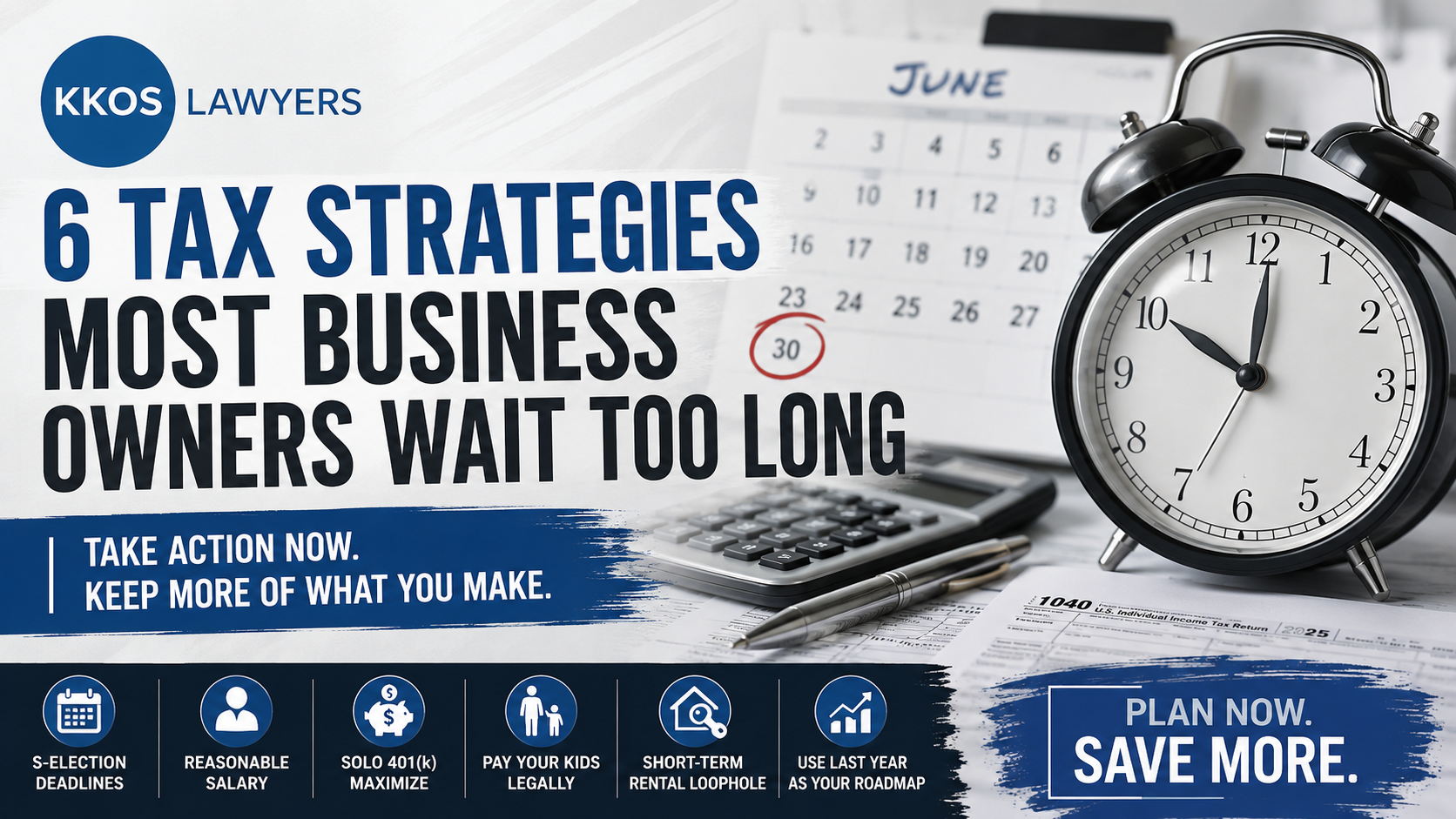
Six Tax Strategies to Review Before the Window Closes
Most business owners don’t lose money on taxes because the strategies are secret. They lose money because they wait. Six strategies with real deadlines, from S-election timing to the short-term rental loophole.
Bring your questions to the table.
Reading is a good start. A 60-minute paid consult with a partner-level attorney turns it into a written plan you can act on.
Ready to get started? Book a free 15-minute call with one of our client advisors and start preparing with confidence.
Schedule a New Client Call →Six Tax Strategies to Review Before the Window Closes
Let’s be honest with each other for a second. Most business owners don’t lose money on taxes because the strategies are some big secret. They lose money because they wait. They sit down with their CPA in March, staring at last year’s return, and hear the same sentence every single time: “Man, if we’d only done this back in June.”
I don’t want that to be you this year. So let’s walk through six strategies, real ones, straight out of the tax code, that I talk about with clients all the time. Some of these have a clock on them. Read this, then go do something about it.
1. “Backdating” Your S-Election (Kind Of)
Here’s a question I get all the time: “Can I just backdate my S-election paperwork?” No. Don’t do that. But here’s the good news, the IRS actually built in a legitimate way to get almost the same result.
Under Rev. Proc. 2013-30, if you missed the deadline to file your Form 2553, you can often still get the election treated as effective back to the date you meant it to start. However, it’s important to calculate the late fees and penalties of backdating past the current taxable year that you’re in.
The Rule allows you to backdate to formation of the entity creation day, but that doesn’t mean you always should go back that far, meet with a tax professional to determine what allows for the most tax savings.
2. Keep Your S-Corp Salary Reasonable, Not Guessy
I hear this one constantly: “My buddy told me I only have to pay myself a third of my profit as salary.” Nope. That’s not a rule anywhere in the tax code. I wish it were that simple.
Often times your CPA is going to become very conservative on determining what your reasonable compensation should be. I use a Payroll Matrix that helps show what you should allocate for your reasonable compensation. But, I don’t ever want to see reasonable compensation to be over $100,000. At very least, get a consultation and we can help determine what that reasonable compensation should be.
3. Solo 401(k): Stack the Deck for Retirement
I love the Solo 401(k). It’s one of my favorite tools in the whole toolbox, and for 2026 the numbers are better than ever. You can put in $24,500 as the employee, plus another 25% of your compensation as the employer, up to a combined $72,000. Fifty or older? Tack on another $8,000. Between 60 and 63? Even more.
If you run an S-corp, remember your employer contribution rides on your W-2 wage, so this ties directly back to strategy number two. You can’t max out your retirement plan on a salary you set too low. And here’s the part people miss: the plan itself has to be up and running by December 31 if you want to make an employee deferral for the year. Miss that date and you’ve missed your shot, at least for the employee side.
Got a spouse legitimately working in the business? Put them on payroll and let them run their own Solo 401(k) too. Now you’re doubling up as a household, and that adds up fast.
4. Pay Your Kids (Legally, and the Right Way)
This might be my favorite strategy in the whole list, because it does two things at once: it saves you real money, and it teaches your kids what work actually looks like. Here’s how it works. You hire your kid to do real work in the business. You pay them a fair wage. That wage is a deductible expense for you.
Now here’s where it gets fun. In 2026, your child can earn up to $16,100 and pay zero federal income tax on it, because that’s their standard deduction. Zero. And if your business is a sole proprietorship, or a partnership where the only partners are the kid’s parents, wages to a child under 18 also dodge Social Security and Medicare tax entirely.
However, we want to avoid paying minor children out of the S-corp directly. We are going to look at creating a Family Management Company (FMC) to run this through and this will allow for us to “have our cake and eat it too!”
5. The Short-Term Rental Loophole
Real estate investors, listen up, because this one has a ticking clock on it this year. Normally, rental losses get stuck in passive-loss jail. You can’t use them to offset your W-2 income unless you qualify as a real estate professional, and let’s face it, most people with a full-time job simply can’t rack up those hours.
But there’s a carve-out. If your average guest stay is seven days or less, the IRS doesn’t automatically treat that property as a rental activity in the first place. Combine that with material participation, generally over 100 hours and more than anyone else involved, and suddenly your losses aren’t passive anymore. They’re non-passive, which means they can offset your active income directly.
Layer in a cost segregation study and the restored 100% bonus depreciation for property placed in service after January 19, 2025, and you can generate a serious first-year loss. But here’s the catch: you generally have to place that property in service and log your participation hours within this calendar year. The clock is running right now, not next April. Keep your booking records, your hour logs, and your cost segregation study. That’s what survives an audit, not just the idea of the strategy.
6. Your Past Return Is Your Best Roadmap
Here’s the strategy that ties everything else together: stop treating tax planning like a once-a-year event. Your prior year’s return is basically a report card. It tells you exactly what got done, what got missed, and what got half-finished.
A real, comprehensive tax consultation means sitting down, comparing this year’s income and entity setup against what actually happened last year, and asking, “What are we going to do differently this time?” Because here’s the truth: almost everything in this article, the S-election timing, the Solo 401(k) setup, the STR placed-in-service date, the payroll number, has a deadline that hits before your return ever gets filed. If you wait until tax season to think about taxes, you’ve already missed most of your best moves.
Put this on the calendar. Make it a habit, not a one-time chat. That’s how you actually keep more of what you make.
This article is for general informational purposes and does not constitute individualized tax or legal advice. These strategies depend heavily on your entity structure, income level, and specific facts, so review them with a qualified tax professional before implementing anything above.
Book a call or learn more about how we can help with your business